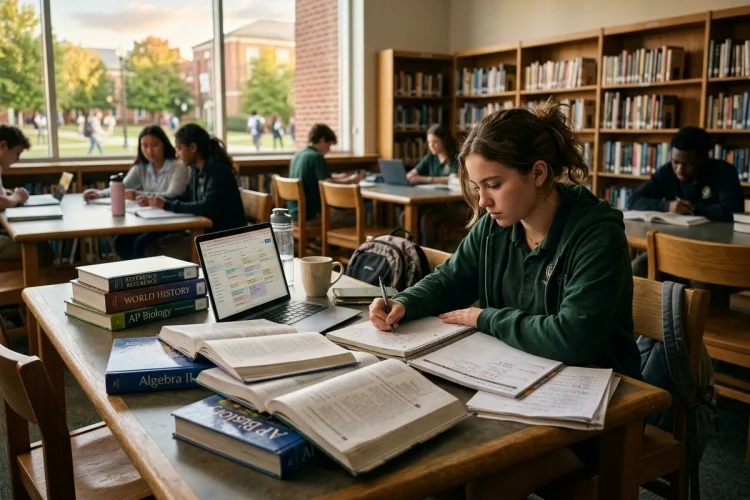
Some school years simply feel harder than others.
Maybe the classes are more demanding, your grades are not where you want them to be, friendships are changing, or you are trying to balance exams, assignments, activities, and expectations from several directions at once.
During periods like these, resilience becomes especially valuable. Building resilience during a difficult school year does not mean pretending that everything is fine or forcing yourself to stay positive all the time.
Resilience is more about adapting to challenges, recovering after setbacks, and continuing to move forward even when things do not go according to plan.
Research involving adolescents has found that resilience can help reduce some of the negative effects of academic stress on school adjustment. At the same time, support from teachers, friends, family members, and the wider school environment matters too.
The good news is that resilience is not just something you either have or do not have. You can strengthen it through the way you respond to stress, organize your workload, seek support, and recover from difficult days.
Accept That a Difficult Year Will Have Difficult Days
Resilience does not begin with eliminating stress.
It begins with accepting that some stress, disappointment, and uncertainty are part of a demanding school year.
You may study hard and still receive a disappointing grade. A presentation might go badly. You may struggle with a teacher, lose motivation, or feel overwhelmed by several deadlines arriving at once.
The goal is not to treat every difficult moment as a disaster.
Instead of thinking, “This year is ruined,” try narrowing the problem down: “This week has been difficult, and I need to figure out what would make next week more manageable.”
That shift matters because temporary setbacks become easier to handle when you stop treating them as permanent judgments about your ability.
Research among Korean adolescents found that academic stress was associated with poorer school adjustment, while resilience appeared to reduce some of that negative relationship.
Separate What You Can Control From What You Cannot
A difficult school year can feel overwhelming because many problems arrive at the same time.
Some are within your control. Others are not.
You cannot control exactly what questions appear on an exam, whether another student likes you, or every decision a teacher makes.
You can control how you prepare, when you ask for help, whether you complete practice questions, and how you respond after a disappointing result.
Imagine receiving a poor mathematics grade.
You cannot change the score that has already been recorded. But you can review your mistakes, ask the teacher what you misunderstood, change your study strategy, and prepare differently for the next test.
Resilience grows when you redirect energy away from repeatedly worrying about what has already happened and toward the next useful action.
Ask yourself:
“What part of this situation can I influence today?”
The answer does not have to solve everything. It only needs to give you somewhere productive to begin.
Break Academic Pressure Into Smaller Problems
Stress becomes harder to manage when your brain treats the entire school year as one enormous problem.
You might think:
“I have exams, three assignments, a presentation, soccer practice, and I’m falling behind in chemistry.”
No wonder you feel overwhelmed.
Separate the workload.
Identify the Most Urgent Task
Maybe tomorrow’s chemistry assignment deserves attention first.
Choose One Concrete Action
Instead of “study chemistry,” decide to complete questions 1–10 and review one difficult concept.
Plan the Next Step
Once that task is finished, move to the next priority.
Breaking large demands into smaller actions does not reduce the total amount of work, but it makes the workload psychologically easier to approach.
The same principle applies after failure. Instead of trying to “fix my grades,” identify one subject, one weakness, and one action.
Resilient students do not necessarily have fewer problems.
They become better at turning large problems into manageable ones.
Build a Support System Before You Really Need It
Trying to handle an entire difficult school year alone can make every problem feel heavier.
Relationships matter.
The CDC describes school connectedness as feeling that adults and peers at school care about students as individuals and about their learning. It identifies connectedness as an important protective factor linked with student health and well-being.
Support can come from several places.
A teacher might explain a difficult topic. A friend can study with you. A parent or family member can help you think through a stressful decision. A counselor may help when academic or personal pressure becomes difficult to manage.
Asking for help is not evidence that you lack resilience.
It can actually be part of resilient behavior.
If you are falling behind, talk to someone before the situation becomes much larger. Saying, “I’m having trouble understanding this chapter-could you help me figure out where I’m going wrong?” is much more useful than quietly struggling for another month.
Be Careful How You Talk to Yourself After Failure
Imagine failing an important exam.
Your first thought might be:
“I’m stupid.”
“I’ll never understand this.”
“Everyone else is better than me.”
Those statements feel convincing when you are disappointed, but they turn one result into a judgment about your entire ability.
A more resilient response is specific:
“I performed badly on this exam. I need to understand why.”
Maybe you started studying too late. Perhaps you understood the material but struggled with time management. Maybe your study technique was ineffective.
Research involving university students experiencing chronic academic stress found that greater self-compassion was associated with less negative emotional response to that stress.
Self-compassion does not mean making excuses.
It means responding to difficulty without adding unnecessary self-criticism.
You can hold yourself accountable while still treating yourself like someone who is learning.
Protect Your Basic Routine When School Gets Busy
When academic pressure increases, basic routines are often the first things students sacrifice.
Sleep becomes shorter. Meals become irregular. Exercise disappears. Every evening turns into another long study session.
That strategy can become counterproductive.
One study of 1,232 adolescents found associations between academic stress, anxiety, school burnout, and poorer sleep quality.
Because the study was observational, it does not prove that academic stress alone causes sleep problems, but it highlights how closely these factors can interact.
During a difficult school year, aim for a routine you can maintain rather than an extreme one.
Give yourself realistic study periods. Take breaks. Get regular sleep when possible. Include movement, meals, hobbies, and time with people you enjoy.
Recovery is not separate from resilience.
It is part of what allows you to return to difficult work tomorrow.
Use Setbacks as Feedback, Not Final Results
Resilient students are not students who never fail.
They are students who know what to do after failure.
Suppose you prepared for two weeks and still received a disappointing biology score.
Instead of immediately studying twice as many hours for the next exam, investigate what happened.
Did you spend most of your time rereading instead of practicing recall?
Were there specific chapters you misunderstood?
Did anxiety interfere with your performance?
Was your preparation inconsistent?
The lesson might not be “work harder.”
It might be “change the method.”
This mindset transforms setbacks into information. You are no longer asking whether you are capable of succeeding. You are asking what adjustment could improve your next attempt.
That creates a path forward-which is exactly what resilience needs.
Stay Connected to Life Outside Your Grades
School matters, but your grades are not the entirety of your identity.
When academic performance becomes the only way you measure yourself, every bad result can feel enormous.
Keep some connection with activities that remind you that life contains more than assignments and examinations.
Spend time with friends. Play a sport. Make music. Read something unrelated to your classes. Help at home. Work on a hobby simply because you enjoy it.
UNICEF’s guidance for reducing student stress emphasizes positive coping activities and supporting students’ overall well-being rather than focusing only on academic demands.
A balanced perspective can make setbacks easier to absorb.
A bad mathematics grade means you received a bad mathematics grade.
It does not mean you are a bad person, an unsuccessful student forever, or someone without a future.
Notice the Progress You Are Already Making
A difficult year can make progress surprisingly difficult to see.
You naturally focus on unfinished assignments, upcoming exams, and everything you still need to improve.
Occasionally look backward.
Maybe a subject that terrified you in September feels manageable now. Perhaps you have become better at speaking in class, organizing your notes, asking teachers for help, or recovering after disappointing grades.
Those improvements count.
Resilience develops gradually through experiences of facing difficulty and discovering that you can adapt.
Research on adolescents and school adjustment supports the idea that resilience can function as a protective factor when academic stress is high.
Keep a simple weekly note:
“What did I handle better this week than I would have handled a few months ago?”
You may discover that the difficult school year is teaching you skills that are not visible on your report card.
Learning how to build resilience during a difficult school year does not require becoming fearless, endlessly productive, or unaffected by stress. Resilience is the ability to keep adapting when school becomes challenging.
Focus on what you can control, break large problems into manageable actions, maintain supportive relationships, protect your basic routines, and treat setbacks as information rather than permanent failures.
Most importantly, remember that asking for help can be part of resilience, not the opposite of it. Choose one challenge that currently feels overwhelming.
Instead of trying to solve the whole problem today, identify one small action that could make it slightly easier. Send the email, review the chapter, talk to the teacher, or adjust your schedule. Resilience grows through those small decisions to keep moving forward.